
The 2025 Local Business Impact Survey found 93% of small businesses have reopened post-Helene, but needs are emerging around flexible capital, lack of commercial real estate, revenue recovery, and infrastructure restoration.
This year marks the 10th anniversary of Mountain BizWorks’ Local Business Impact Survey (LBIS). That’s 3,580 entrepreneurs making their voices heard through their daily wins and challenges, the COVID-19 pandemic, and now Hurricane Helene. Every year is different—regionally and individually for business owners—but each has brought invaluable data and insights into the entrepreneurial practices and spirit of Western North Carolina.
We’re deeply grateful to the more than 700 small business owners from across 23 different WNC counties who took the time to share their experiences for our 2025 survey. Their input helps us understand the impact of Hurricane Helene on their businesses and communities, ongoing needs, and the remarkable resilience of our region.
Local Business Impact Survey Webinar
Watch the webinar recording for more insights from the 2025 Local Business Impact Survey.
In 2025, businesses across the region are still recovering from the devastating effects of Hurricane Helene. The storm significantly disrupted operations and impacted tourism revenue in a time of year that is critical to small business owners. Now, the majority of businesses are open and preparing for what the region hopes to be a season of growth this fall.
As we look ahead, it is our hope that this report will guide thoughtful action, responsive investment and long-term support for locally rooted businesses throughout the region.
A Summary Of Key Insights
Businesses suffered significant trouble reopening due to the loss of utilities, access to roads, loss of inventory, and physical damage, to name a few.
- 96% of small businesses were impacted by Hurricane Helene, 52% sustaining physical damage and two-thirds losing all major utilities (power, water, and internet).
- Businesses reported $188 million in combined physical and economic damages, yielding a median economic loss per business of $95,000 and an average loss of $322,000.
- 83% of businesses had to close temporarily due to the storm’s effects.
Small businesses were at the center of recovery efforts.
- Small businesses provided leadership around clean up efforts, resource coordination, and developing as resource hubs. Over 80% reported playing an integral role in their community.
- Small businesses across the region formed new partnerships, resource networks, and resilience hubs—often with cross-sector collaboration among businesses, government, and nonprofits—laying the groundwork for a stronger, united recovery.
Small businesses are open and recovering, but revenue still lags pre-Helene levels.
- Western North Carolina is open for business with 93% of small businesses now open with the remaining 7% to reopen yet in 2025.
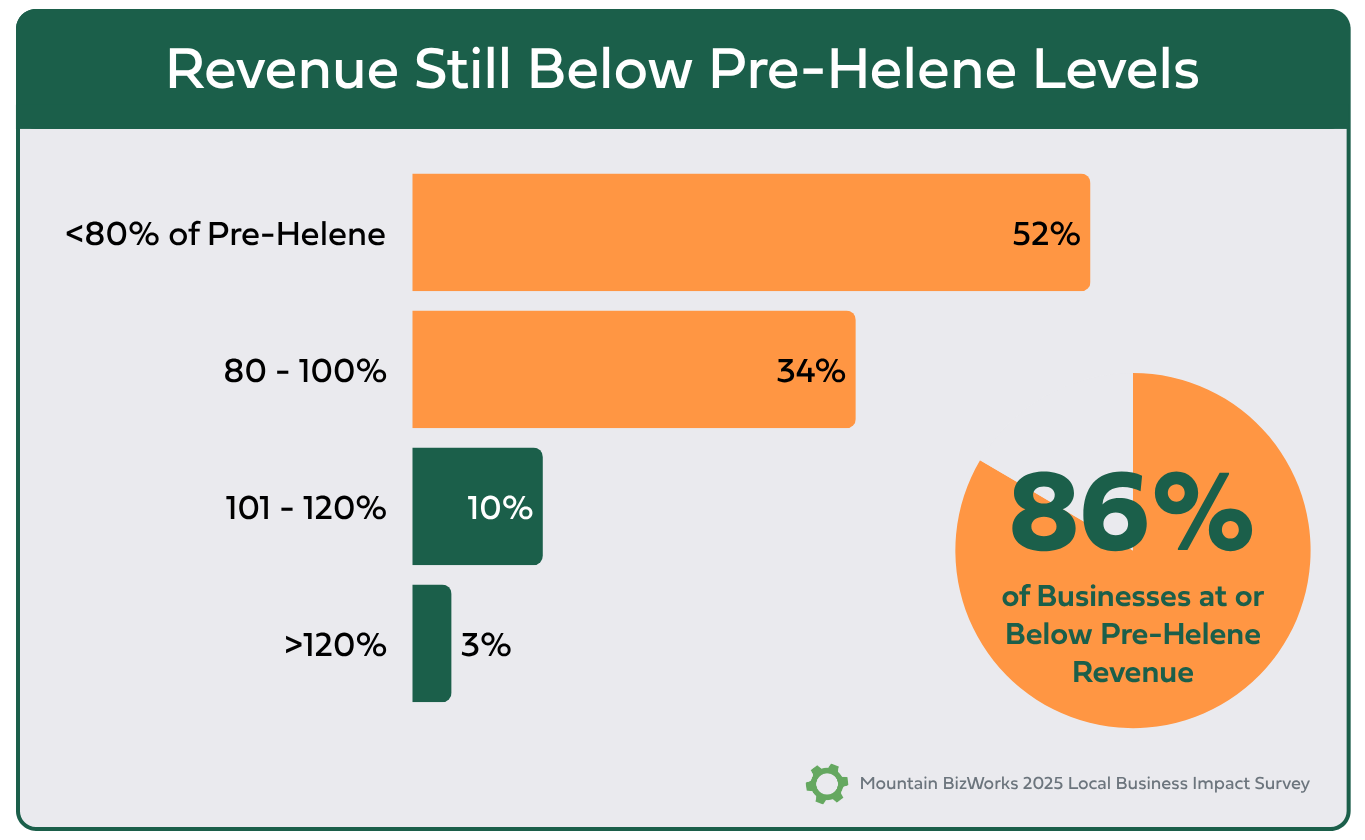
- 86% of businesses are still earning at or below pre-Helene levels, and half of all businesses are down 20% or more, reflecting ongoing regional economic challenges.
Business owners urge flexible capital, affordable commercial space, and investment in tourism, outdoor assets, and infrastructure restoration to recover and thrive.
- Flexible and forgivable capital remains essential for rebuilding and resilience as many business owners still face loan repayment from COVID-19 and other debt commitments.
- Affordable, move-in-ready commercial space is limited—shared and mixed-use options are highly sought after for faster recovery and growth.
- Businesses identified the critical role of information and guidance from local small business support organizations, as well as the immense value of peer support networks in navigating recovery. They need ongoing support and up-to-date information while managing things like insurance claims, long-term financial planning, collaborative rebuilding strategies, and access to resources.
- Trails, sidewalks, greenways, and other outdoor assets are critical to the region’s economic health and must be rebuilt. Business owners see these as essential not only for local quality of life but for tourism and regional identity.
- While most WNC businesses have reopened, lingering misconceptions about widespread devastation continue to impact tourism.
Part I: Widespread Devastation – Understanding the Impact of Hurricane Helene on WNC Small Businesses
Western North Carolina is a small business-driven economy. In fact, 99% of all businesses in the WNC region are small businesses according to the NC Department of Commerce. Given their importance on our region’s economy and our culture, the 2025 Local Business Impact Survey aimed to establish a deeper understanding of Hurricane Helene’s impacts on small businesses, how these businesses are recovering, and what is still needed for WNC to thrive again
It is clear that Hurricane Helene brought unprecedented challenges to our region’s businesses. 96% of responding businesses owners reported negative impacts from the Helene disaster. The range of impacts are illustrated below.
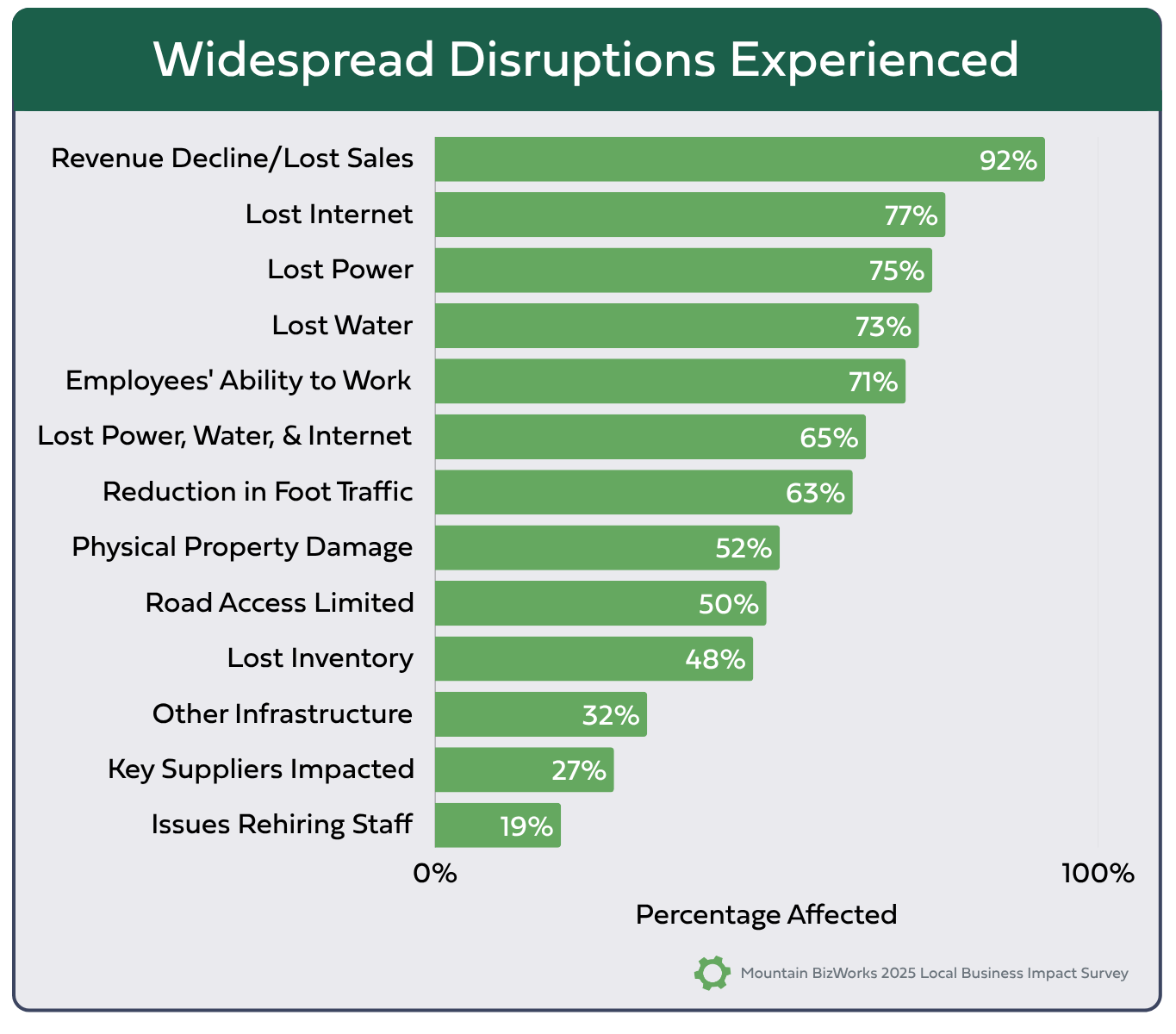
Most businesses (92%) experienced revenue losses and around half of businesses (52%) sustained direct physical impacts from the storm. Two-thirds of all respondent businesses lost access to power, water, and internet, breaking the connection to daily basic needs that allow not only homes but small businesses to function. The loss of utilities also caused delays in accessing information on emergency response resources and remediation.
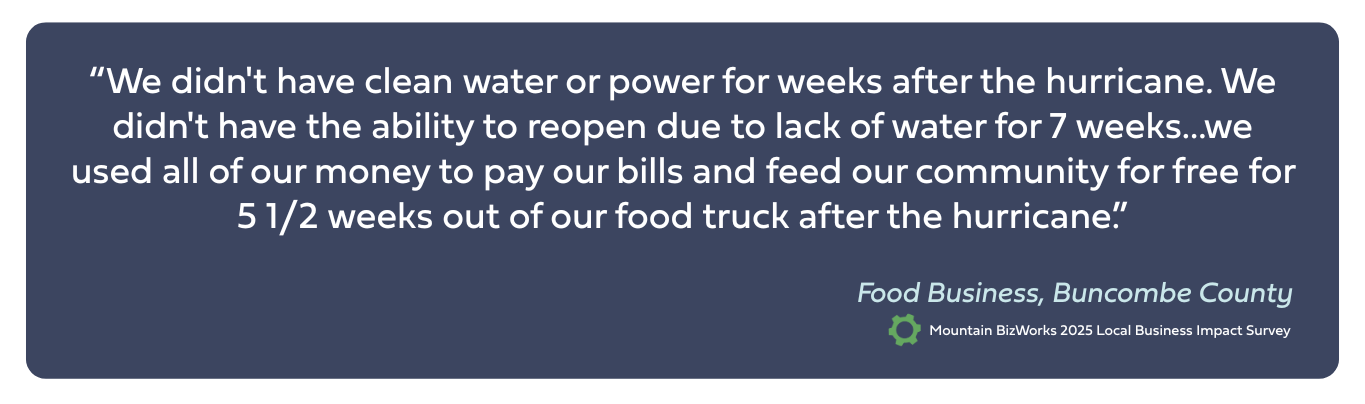
A more personal impact that caused significant disruption post-Helene was difficulty in maintaining and bringing back staff. Inability to provide consistent hours, a clear path to reopening, and other barriers affected 71% of business owners. Employees and owners were dealing with difficulties within their homes, families and personal networks.
Estimated Economic & Physical Damages
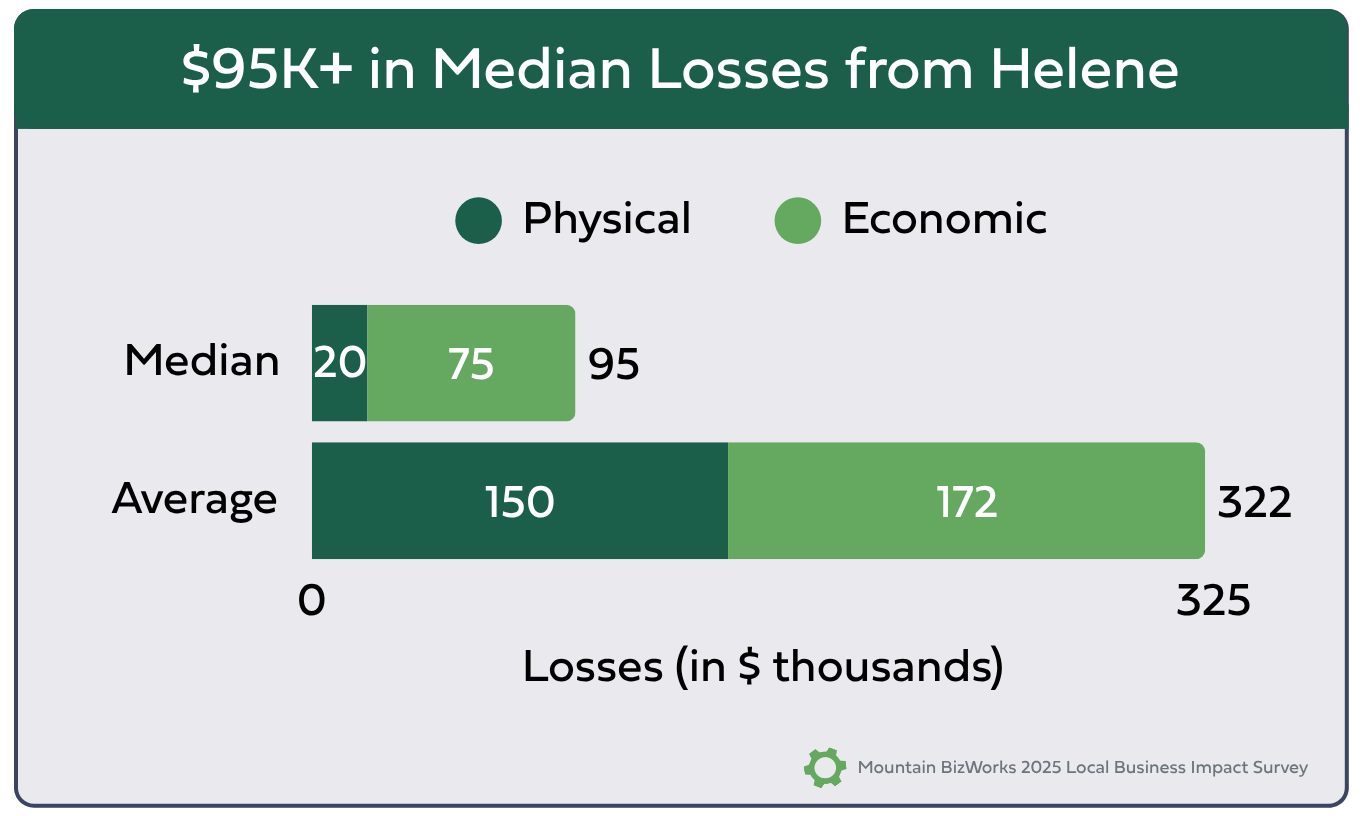
Over $188 million in combined physical and economic damages were reported by the small business owners that we surveyed. The median impacts sustained by WNC small businesses included $20,000 in physical damage and $75,000 in economic losses, for a combined median impact of $95,000. Average impacts were much higher, reflecting how many businesses faced severe impacts. On average, businesses experienced $150,000 in physical damage and $172,000 in economic losses, resulting in a combined total of $322,000 in average impacts.
Small Business Closures
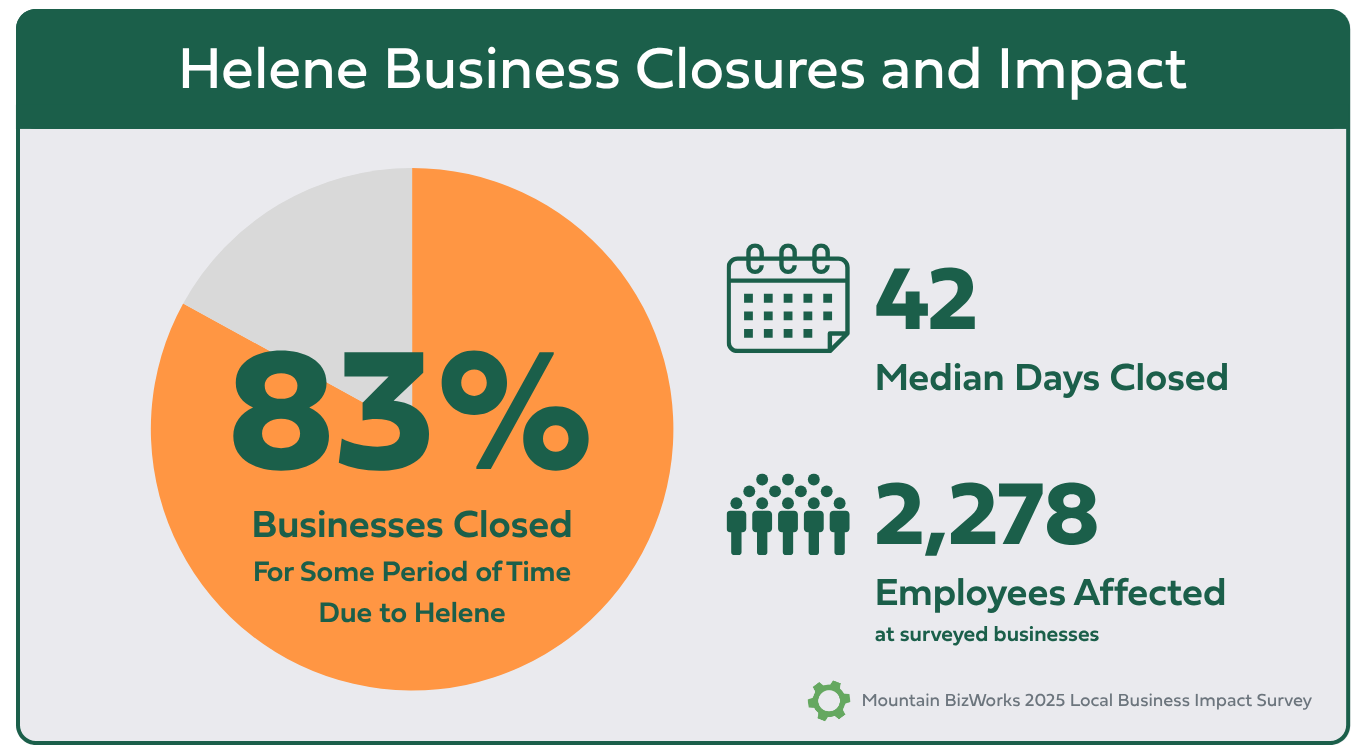
Due to the widespread physical and economic disruptions faced, over 8 in 10 WNC small businesses were forced to close for an extended period due to Hurricane Helene. The median number of days closed was 42.
Later in this report, we explore how external communications around the disaster, combined with the region’s uneven path to reopening, created additional challenges for recovery and visitor perception.
Small Businesses were Recovery Superheroes
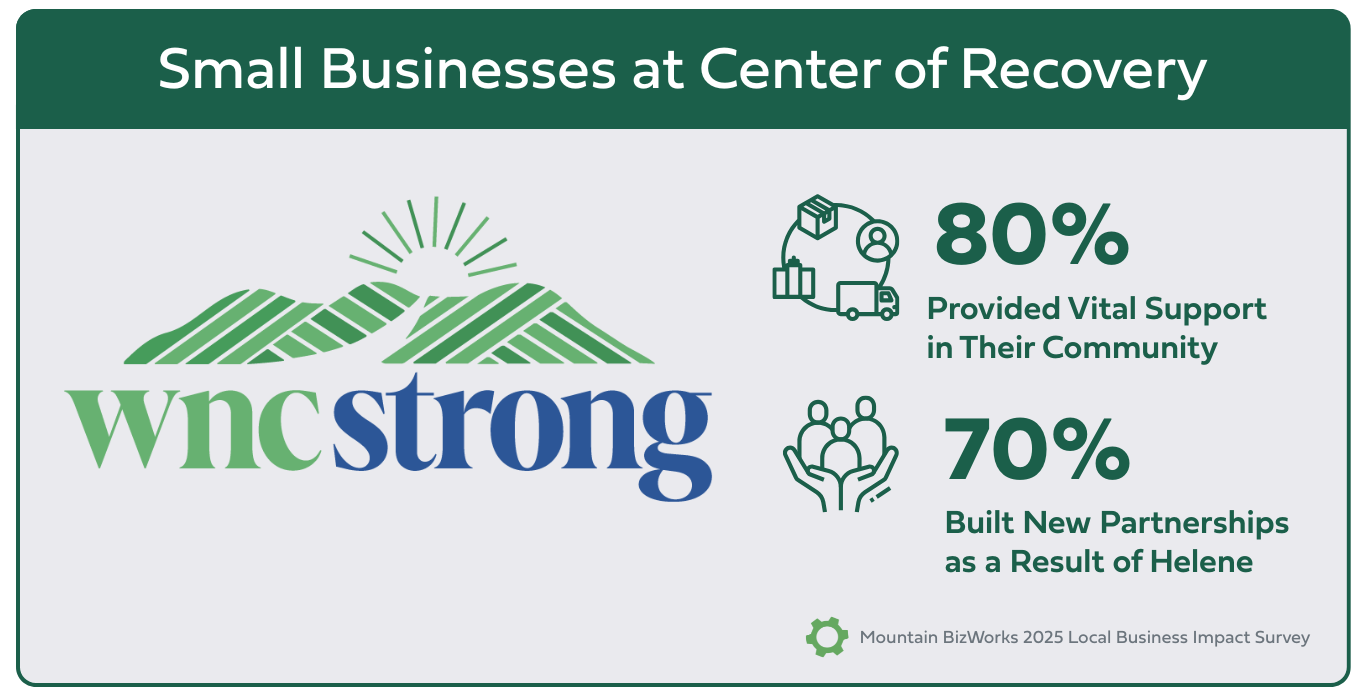
Even while they were experiencing so much personal and professional loss, small businesses shone in extraordinary ways. More than 80% reported providing vital support in their own community. We saw restaurants cooking and giving away food for free. Neighbors helped clean mud from homes and retail spaces. Other businesses became distribution sites, sharing the supplies and resources the community needed in the early days of the disaster.
The encouraging, collaborative energy continues in newly formed partnerships around shared spaces, businesses networks & coalitions, and community events. Over 70% of our respondents reported that these partnerships were a direct result of the storm. These collaborations between small businesses, government, and nonprofit organizations are ongoing, and have built a foundation that will continue to serve as a beacon in the ongoing recovery across the region.
Part II: On the Road to Recovery – Small Businesses are Open and Recovering, but Revenue Still Lags Pre-Helene Levels
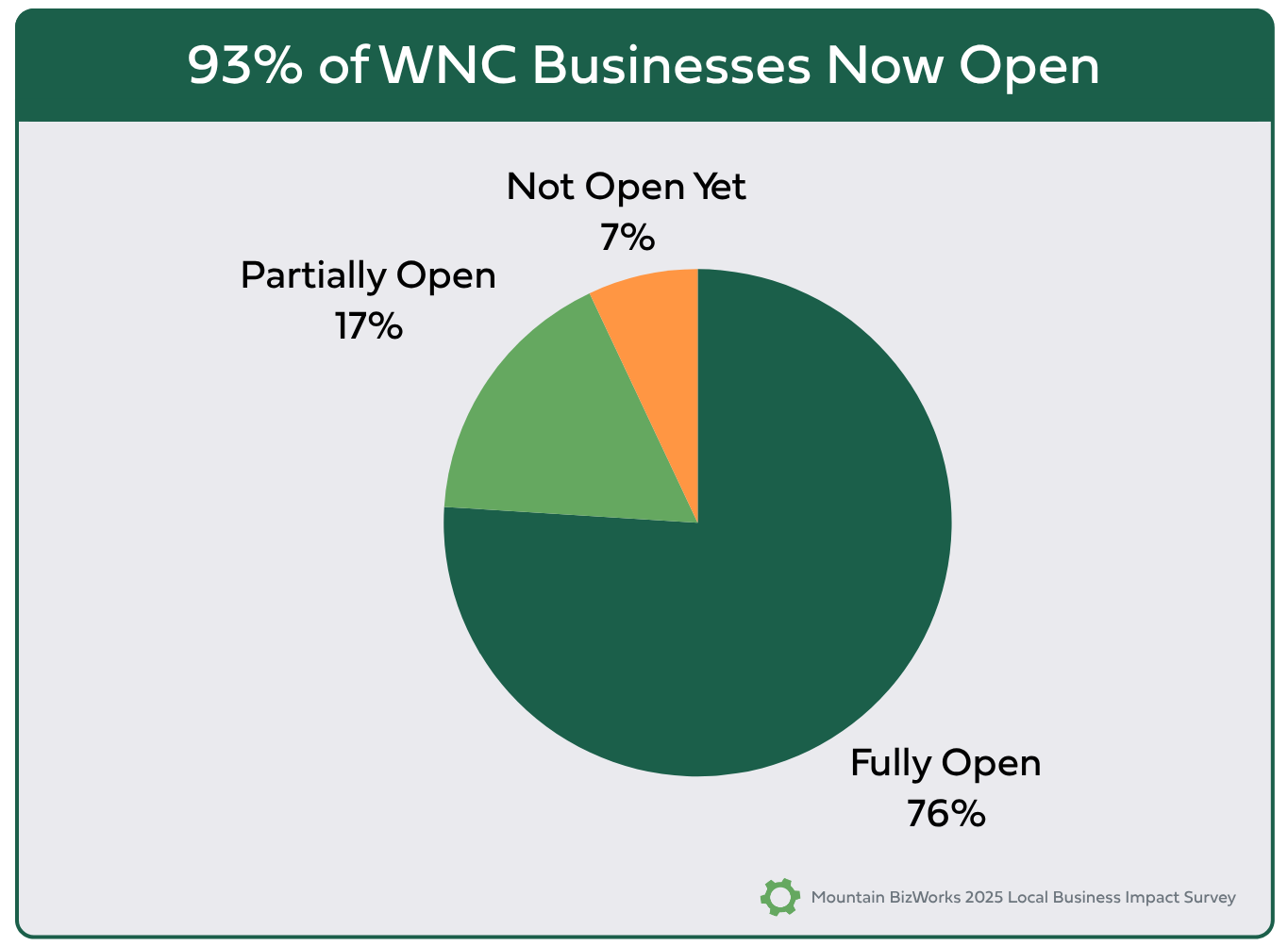
One of the most encouraging survey findings is that 93% of small businesses are now open – Western North Carolina is truly open for business again! While revenue is still lagging (more on this below), businesses reopenings represent a major milestone on the road to recovery. 76% are fully open while 17% are open in a limited capacity such as with reduced hours. For the limited number still working toward reopening (7%), most anticipate being back in operation by the end of September 2025.
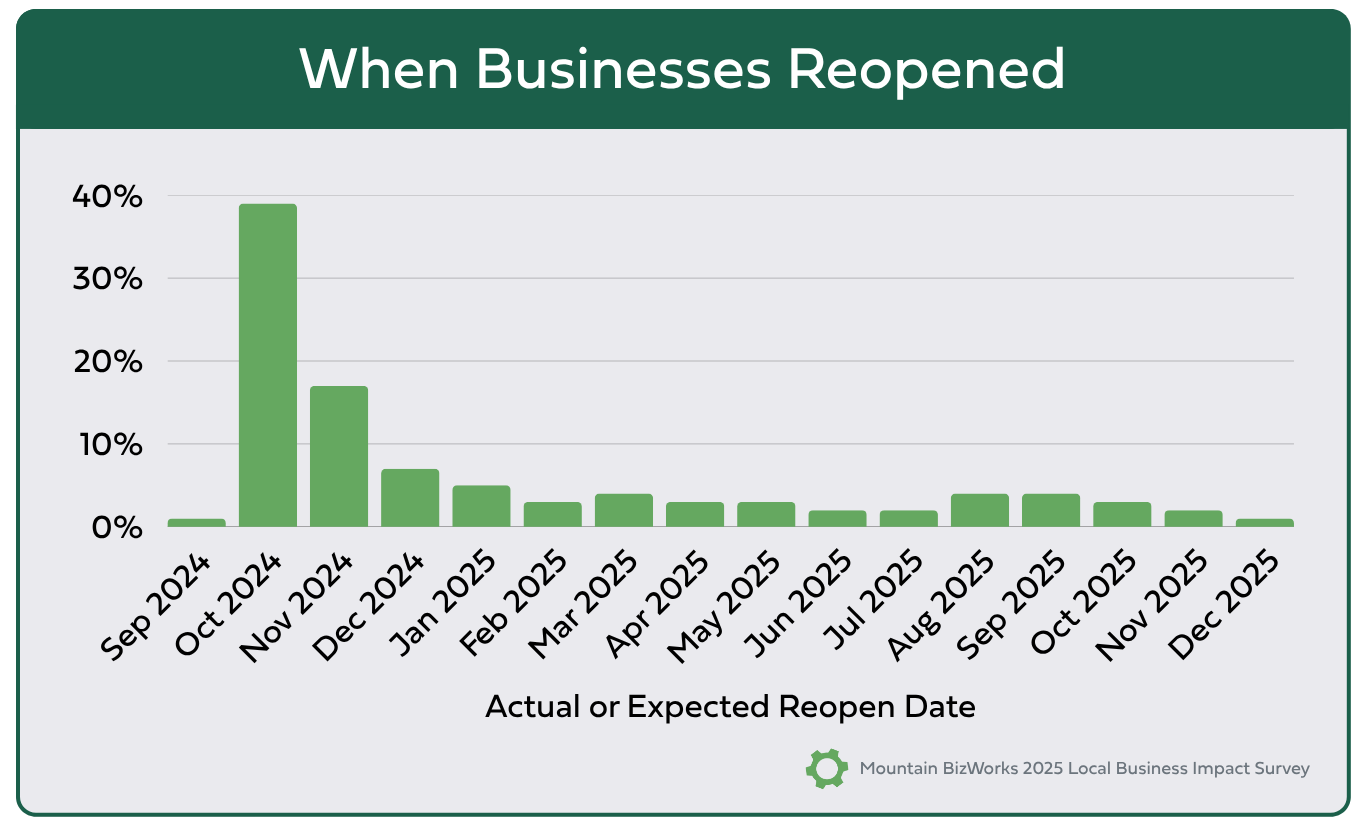
Revenue loss was nearly universal, with 92% of small businesses experiencing a drop in sales after Helene. Nine months later, 86% are still earning less than they did before the storm. Further, revenue for more than half of those businesses are still more than 20% below pre-Helene levels. While certainly improving, this suggests the region is still facing substantial ongoing economic challenges.
Small businesses will need to remain proactive to navigate this period and would greatly benefit from additional recovery assistance, continued local patronage, and the return of tourism. National economic conditions and the uncertain impacts of tariff policies will also affect the region’s recovery outlook.
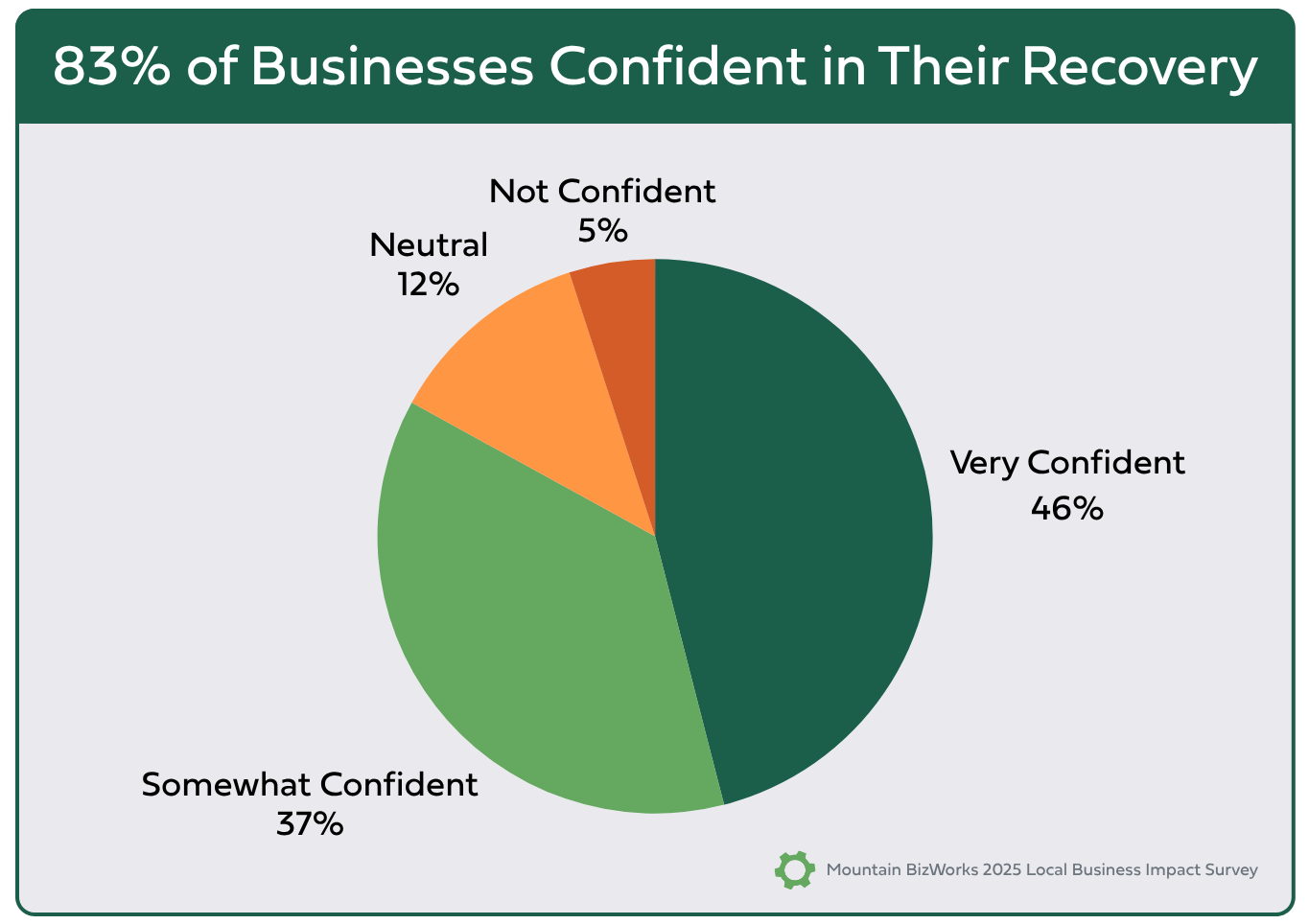
Businesses across the region are looking ahead with optimism—83% express confidence in their ability to fully recover. Encouragingly, this confidence is consistent across all demographics, including geography, gender, and race. We also observed a slight boost in confidence among those who have participated in Mountain BizWorks’ peer-based courses and one-on-one specialized coaching over the past twelve months, highlighting the positive impact of targeted support programs.
The Importance of Access to Rapid Recovery Funding
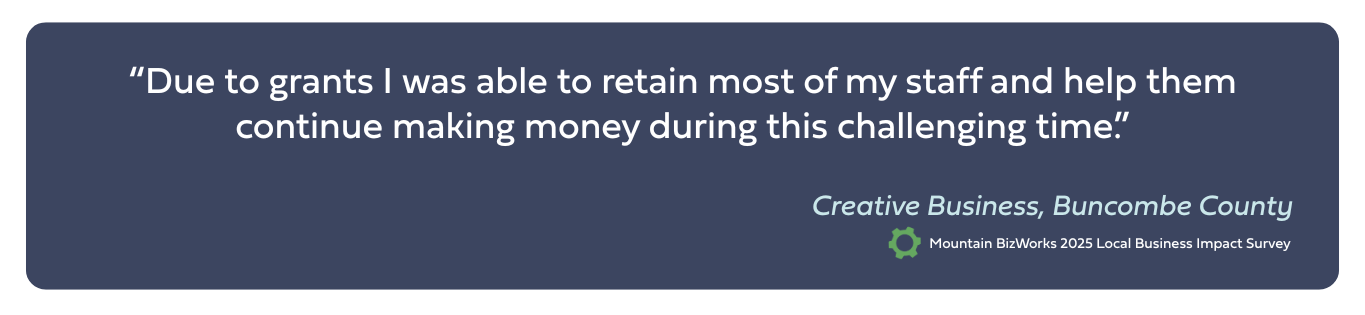
According to FEMA, 40-60% of small businesses may permanently close after a natural disaster of the scale of Hurricane Helene. Thus far, Western North Carolina small businesses are exhibiting substantial resilience. In addition to strong local support for our small businesses, access to rapid recovery funding—such as through the WNC Strong: Helene Business Recovery Fund—has shown a strong correlation with the ability to reopen. Businesses that received recovery capital were significantly more likely to be fully open, underscoring the critical role that early-stage financial support plays in navigating the months after disaster. Programs like this allow small business owners to maintain momentum, retain employees, and rebuild operations while other sources of support (insurance, federal relief, etc.) remain delayed.
New and Sustained Businesses Highlight Regional Resilience
Out of the survey respondents, 153 businesses reported starting in the past year attributable to Mountain BizWorks services, showcasing the innovation and creativity that keep this region locally owned and deeply invested in its communities.
Additionally, Mountain BizWorks services supported 4,694 jobs across Western North Carolina. 3,917 jobs were retained, 1,539 new jobs were created, and 488 positions were open and waiting to be filled.
Part III: The Path Forward – Business Owners Need Flexible Capital, Technical Support, Access to Affordable Space and Outdoor Infrastructure for Long Term Recovery
Thus far, the survey has illuminated just how severe Helene’s impacts were on WNC’s dynamic small business economy, and also the encouraging progress our businesses and communities have made on the road to recovery. That said, we know recovery is a long term journey that will require a sustained focus and strategic investments over the coming years.
A significant portion of the 2025 Local Business Impact Survey gathered input from our small business owners on the most pressing ongoing needs and opportunities to ensure a robust and resilient recovery. Here are the top issues identified by the respondents followed by a deeper dive into each topic:
- Business Recovery Capital is Critical: many small businesses are still struggling and urgently need relief funding to meet payroll, restock inventory, and stabilize revenue. Grants, forgivable loans, and more patient terms for existing recovery loans were all prioritized.
- Pressing Need for Commercial Space: affordable commercial space was limited pre-Helene and is now a crisis with so many displaced businesses. Lack of availability of affordable, upfitted commercial space is delaying recovery; collaborative solutions and funding are needed.
- Ongoing Technical Assistance & Peer Support Needed to Navigate Recovery: Business owners highlighted the importance of peer networks and small business training programs. Ongoing gaps around insurance challenges, financial planning, and developing new markets remain.
- Infrastructure & Outdoor Assets Drive Economic Health: Damaged roads, parks, trails, and other public spaces must be restored to support small business vitality, community health, and tourism.
- Regional Tourism Recovery & Changing the Narrative is Key: WNC businesses have largely reopened but far too many potential visitors still think WNC is devastated. An ongoing coordinated investment in tourism recovery that highlights our unique local businesses and voices is essential.
- WNC is More than Tourism: small business owners also stressed opportunities to invest in continued economic diversification as we recover.
Business Owners Urge Access to Flexible and Forgivable Capital
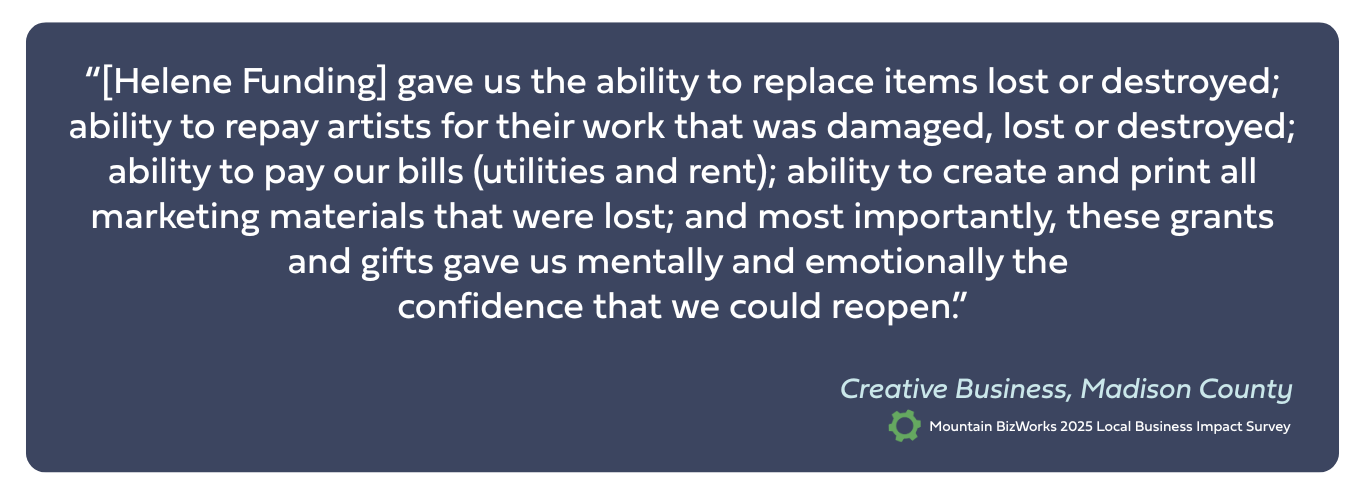
The need for continued recovery capital is a top priority for the next twelve months. One in three business owners identified the need for grants, forgivable loans, or other affordable recovery capital.
Grants continue to be the most sought-after recovery resource within the region. The demand for the available grant programs has far exceeded the level of funding available, so many businesses have yet to receive any significant relief. For example, the WNC Strong Rebuilding Together Grant Fund which Mountain BizWorks administered saw overwhelming demand: a total of 1,127 grant applications were submitted, requesting nearly $25 million in assistance. While 548 grants were ultimately awarded—distributing over $6.8 million in funding—this represents only a fraction of the total need. The scale of requests underscores both the depth of impact and the urgency for continued investment to stabilize and rebuild the region’s small business economy.
Business owners also identified full or partial loan forgiveness as a pathway to relief. Disaster loans like SBA Disaster Loans and WNC Strong Helene Business Recovery Loans are an integral and often required part of the recovery tool box. At the same time, as the loans require repayment out of future business performance, they can reduce the amount of funding available for growth, paying employees, and other business needs. Regionally, this can weigh on economic dynamism. Loan forgiveness based on certain performance requirements such as rehiring and retaining employees, or staying open for at least two years, would be a way to deliver relief while ensuring ongoing economic recovery.
Lastly, many business owners highlighted a request for more patient terms for the WNC Strong Helene Business Recovery Loans. Suggestions included extending the interest-only payment phase and the overall loan term to provide a longer runway for recovery and repayment.
Time Sensitive Need for Affordable and Accessible Commercial Space
Affordable commercial space was limited pre-Helene and is now a crisis with so many displaced businesses. Lack of availability of affordable, upfitted commercial space is delaying recovery; collaborative solutions and funding are needed.
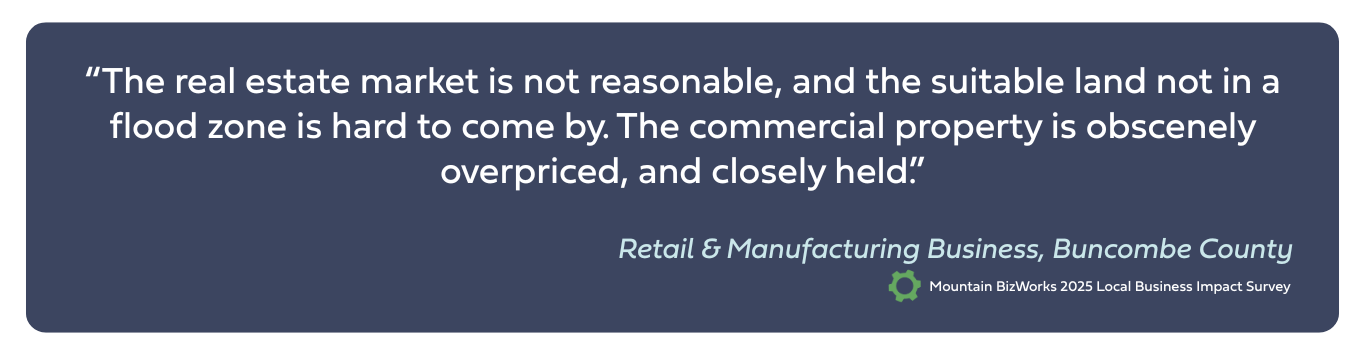
Many businesses are looking to rebuild or relocate while working to rebuild their revenue. The lack of space that is both available and affordable is very limited, and our local economy is feeling the squeeze. The provision of patient, low-cost funding for building owners to restore damaged space (where appropriate) or for the development of new affordable commercial spaces is one possible solution. Tenant upfit grants (or forgivable loans) for Helene-impacted businesses that are rebuilding or relocating would be another valuable tool.
There are creative possibilities that require creative collaboration, flexible funding and innovative structures. This is an opportunity for property owners, community stakeholders, and funders to explore how these gaps could be filled.
Ongoing Technical Assistance, Peer Support, & Recovery Navigation
Business owners identified how important local business support organizations and other local businesses were in their ongoing recovery. Most business owners have never dealt with a natural disaster of the scale of Hurricane Helene (although there are some parallels with the Covid-19 pandemic). They are experts in their day-to-day business, not managing through disaster business interruption, team impacts, revenue loss, insurance claims, and rebuilding permitting.
The information, advice, and relief resources provided by local resources like WNC chambers of commerce, business associations, the SBTDC, and Mountain BizWorks training programs were identified as key supports. They also noted how helpful it was to connect with peers going through similar challenges to share ideas and tactics, to collaborate, or just to commiserate.
Ongoing needs include dealing with insurance claim denials, financial planning, diversifying into new markets, navigating recovery resource programs (SBA disaster loans, grant programs, etc.), tariffs, and general business resilience strategy. Businesses need long term ongoing support navigating the complexity of these systems while continuing to recover.
Restored Infrastructure and Outdoor Amenities Essential to Long-Term Recovery
Unique to Western North Carolina is the deep connection between our natural resources, outdoor recreation, and economic vitality. According to the MADE X MTNS Outdoor Recreation Study, outdoor recreation drives just shy of $5B annually in our region. Business owners recognize this interdependence and are optimistic that restoring trails, greenways, sidewalks, bike facilities, and parks will be central to reviving this critical sector of our economy.
Across the region, we heard a strong call for both the redevelopment and expansion of outdoor amenities in areas heavily impacted by recent disasters. Communities also emphasized the importance of burying utilities where possible to help prevent future disruptions like those experienced during Helene. The outdoor resources that fuel both local quality of life and tourism are inextricably tied to infrastructure—much of which was severely damaged. Investing in expanded and improved outdoor access through greenways, sidewalks, parks, and bike infrastructure is essential to supporting economic recovery and long-term regional growth.
Additional Unmet Needs
Pressing needs around housing, childcare, employee parking, and homelessness continue to challenge long-term recovery efforts. Business owners report that even as they reopen, these pressures may limit their ability to retain workers, serve customers, and stabilize operations. Addressing these interconnected issues is essential to ensuring a resilient and inclusive recovery for the region’s economy.
Tourism Recovery that Supports Local Business Recovery
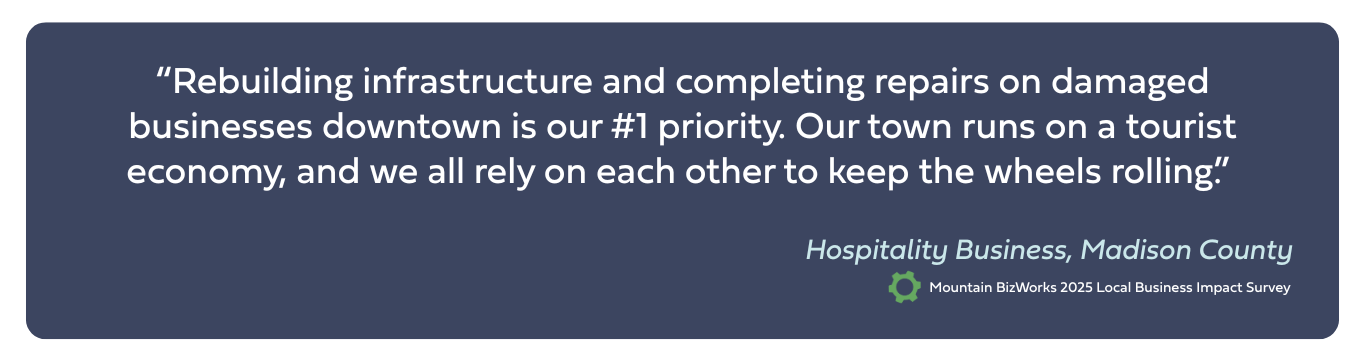
The local entrepreneurs that make Western North Carolina so special from our craft artisans and musicians to our restaurateurs and retailers, are a big driver of regional tourism. As such, a steady level of tourism is needed for many of our small businesses to thrive. Of all our economic sectors, tourism and hospitality have been the most interrupted by Hurricane Helene. Given their centrality to our tourism economy, we asked our local business owners what they think is needed to restore our historically robust tourism sector. Here are their recommendations:
Changing the Narrative: in the immediate aftermath of Helene, people beyond the borders of WNC got the messages of “don’t come” and “WNC is devastated” loud and clear. These messages are sticky and many of the images from the hardest hit areas continue to reverberate through social and traditional media., Survey respondents shared they continue to hear daily from prior customers, asking if it’s safe to travel to the area. A regionally coordinated and well-funded effort is required to communicate that WNC is open again (fortunately, this very thing is underway with tourism agencies and it should be sustained).
Highlight Reopening and Recovery Stories: transition from the stories of devastation to consistently producing and amplifying the amazing stories of resilience and reopening; use local videographers, photographers, and other creative storytellers.
Feature a Diversity of Local Voices & Experiences: ensure a broad range of local businesses and attractions are featured; showcase variety and use this opportunity to push beyond just repeating what is already known.
Marketing Grants to Local Businesses: collectively, local businesses have a huge audience they would like to re-engage. A grants program that would fund marketing initiatives through local businesses would have reach, would leverage trusted networks, and would help overcome the funding constraints businesses are currently facing.
Creative Beautification & Placemaking in Local Business Districts: Helene left scars and debris. In addition to completing the clean up, respondents encouraged harnessing our creativity to see and re-engage our community spaces in a new light. Even small projects can have a big impact in reactivating our local business districts.
Festivals, Events, and More: respondents encouraged helping existing events come back as well as supporting new signature events that highlight (and stimulate) local music, arts, outdoors, and other cultural assets.
Integrate the Arts: the arts are a vital part of WNC’s economy and culture, and this sector has been especially hard hit by Helene. As we invest in tourism recovery, business owners prioritized how the arts can be integrated and supported.
Reopen & Celebrate Our Outdoors: business owners consistently highlighted the need to reopen our parks (especially the Blue Ridge Parkway), and restore our trails and greenways. They also identified an opportunity for new outdoor amenities and green spaces along our waterways to increase resilience.
“Voluntourism”: many suggested ways to continue to link tourism with ongoing regional recovery and rebuilding efforts.
Prioritize investments that are Good for the Local Community First: throughout the responses, businesses owners noted that great places to live are great places to visit. They stressed that our tourism recovery investments should be aligned with and advance local community needs.
Continued Support and Resources
For entrepreneurs still seeking resources around continued recovery and resilience, Mountain BizWorks’ fall courses offer peer-based learning opportunities. Entrepreneurs can develop real-world skills and explore new opportunities with a supportive community of other small business owners. Visit mountainbizworks.org/trail map to view upcoming courses, including Future Forward, a workshop series focused on recovery and resiliency planning for businesses of all stages.
The Helene Business Recovery Fund will be available through September 30, 2025 to provide rapid recovery capital for payroll, cash flow for upcoming seasons, marketing, and lingering storm damage.
The WNC Strong collaborative has served as a hub for all resources, coordination of efforts and continued resilience planning. Donate today to continue these efforts and strengthen the path forward for equitable small business recovery across Western North Carolina.
Thank You
Thank you to our incredible interns, Morgan Fox and Emi Maldonado, who supported this project as interns through the Z. Smith Reynolds Foundation and the North Carolina Network of Grantmakers. Without these partners, this work would not have been possible.
We would also like to thank the Mountain BizWorks team, whose commitment to ensuring equity, sustainability and an entrepreneur centric focus remains as the core of the work we do every day.
We do not do this work alone, but in partnership with our peer small business resource partners, TDAs, Main Street Offices, local Economic Development leaders, Chambers and so many others across the region.
Survey Participation
Annually we survey local business owners who were engaged with Mountain BizWorks over the past 12 months with a loan, a class, business coaching, or other program. This year’s survey pool also included those who received Helene recovery assistance from the Helene Business Recovery Fund and the Rebuilding Together Grant Fund. Over 700 small business owners from 23 counties across WNC shared their experiences, providing valuable insight into the region’s recovery.